
Donor communications in minutes, not hours
Editorial process for personalised donor letters automated with GenAI. Production time per letter down from about an hour to a few minutes.
- Year
- 2026
- Service
- GenAI automation, design through operations
Starting point
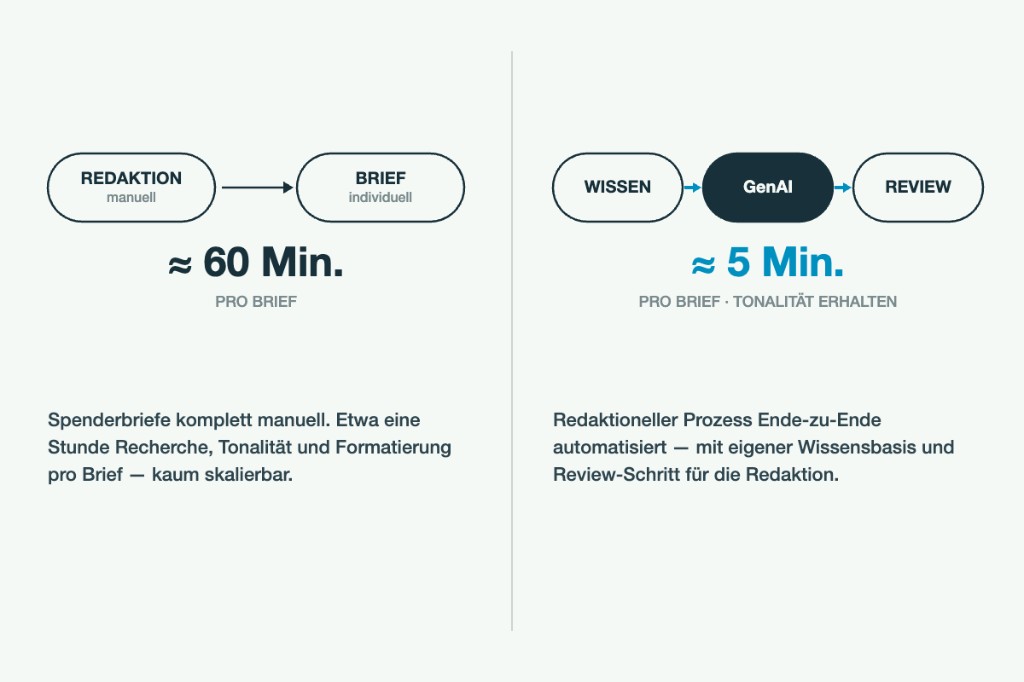
A nationally active NGO (around 350 employees) produced its personalised donor letters entirely by hand. Each letter took around 60 minutes for research, tone adjustment and Word formatting, at a volume that simply could not scale without losing quality.
Approach
We automated the editorial process end to end: source research, text generation in the organisation's house voice, output as a finished Word file with a high level of personalisation. Trained on the specific donor setting, with an approval step for the editorial team.
Delivery
- Research layer for relevant information per project
- GenAI component with tone guidelines and editorial constraints
- Word output with correct formatting and salutation
- Review step for editors before sending
Outcome
Time per letter dropped from around an hour to a few minutes, with the same level of personalisation. The editorial team can now scale projects and deliver faster, without adding headcount.
Which tool for donor communications?
If you look for donor communication software, you mostly find fundraising tools with mail-merge features. That is enough when every donor gets the same letter. It stops where personalisation matters: individual project information per sponsorship, your house tone of voice, and an approval step before sending.
Four criteria decide whether off-the-shelf software is enough or a tailored process is needed:
- Tone of voice: Can the system learn your language, or does every letter sound generic? In the project above, tone guidelines were derived from existing letters.
- Privacy: Donor data is sensitive. Hosting in Germany, no use of data for model training, and a clear data processing agreement are mandatory, not optional.
- Fit with existing systems: The letter must arrive where work happens today: as a formatted Word document, connected to the existing donor database.
- Control: No sending without human approval. Automation speeds up creation, responsibility stays with the team.
Whether a purchased product, an extension of existing systems, or a custom component is the most economical answer can be clarified in a short initial call. If a ready-made tool is enough, we will say so.
Frequently asked questions
Does the personal touch stay when donor letters are automated?
Yes. The system creates drafts based on tone guidelines and individual project information. A person reviews and adjusts before sending. In the project described here, the level of personalisation stayed just as high.
What about privacy for donor data?
Processing runs on servers in Germany. Donor data is not used to train AI models. A data processing agreement covers the details.
How long does implementation take?
In the project described here, two months from analysis to production use, including connections to research sources and Word output.
Does this work with our donor database?
Usually yes. The process builds on data you already have. A short inventory at the start clarifies which systems need to be connected.
What does automating donor communications cost?
That depends on your system landscape and scope. The entry point is a clearly defined pilot project with a fixed time and cost frame. If automation is unlikely to pay off, we will advise against it.
Note: Anonymised case. Sample texts and metrics on request.