
Getting started with AI without an AI department: four agents, one platform
At the 7th workshop on AI in SMEs in Dresden we showed with GWS how a single pilot chatbot became four production agents and a company-wide platform. Without a dedicated AI department.
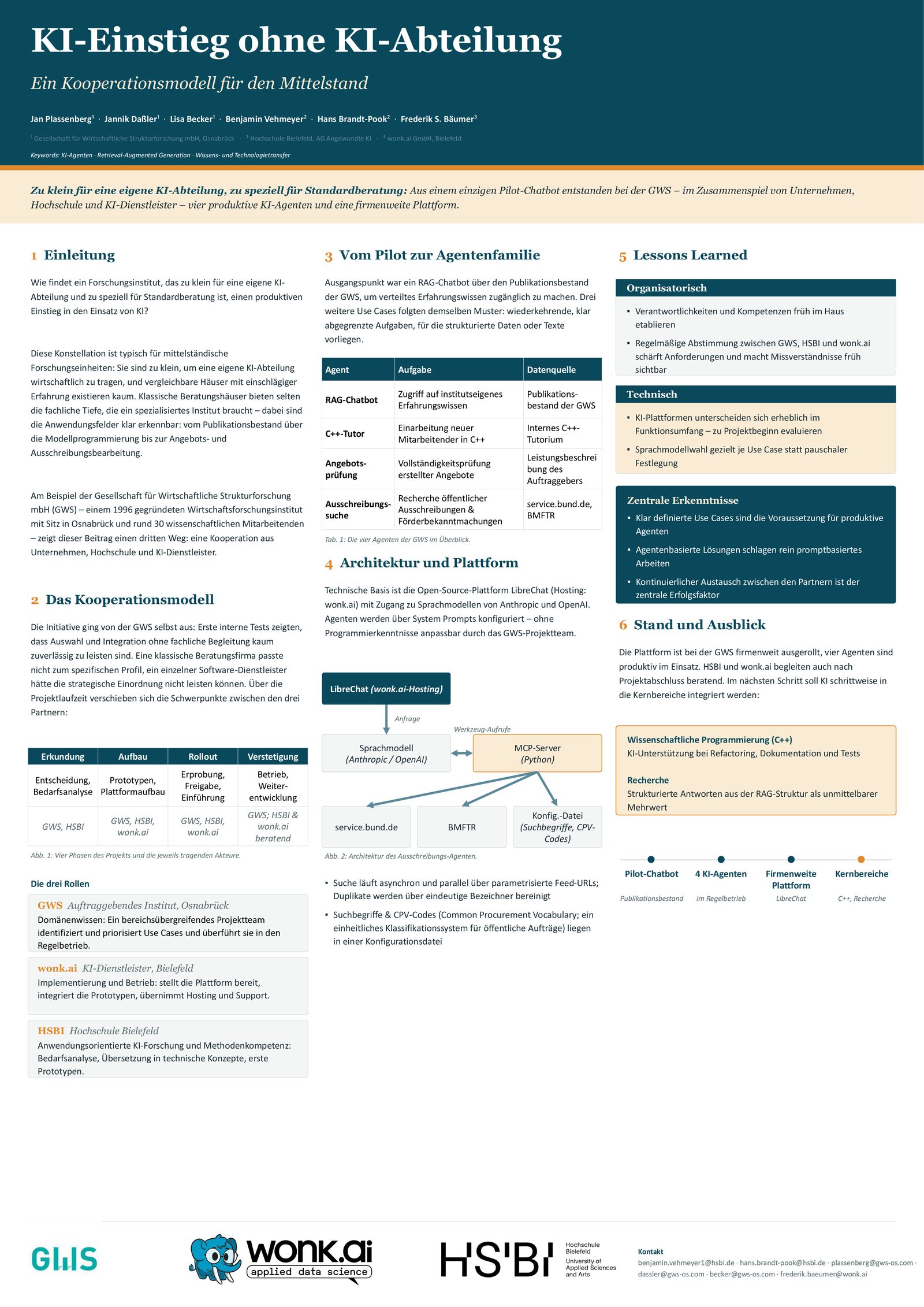
On September 22, 2026, wonk.ai joined the 7th workshop "Artificial Intelligence in SMEs" in Dresden. Not only to listen. In the poster session we presented results from a running cooperation project together with GWS (Institute of Economic Structures Research, Osnabrück) and Bielefeld University of Applied Sciences (HSBI).
We had announced the workshop in August: KI in KMU Workshop 2026: we will be there. Here is what the poster said and what we take away.
The starting point: too small for a department, too specialized for standard consulting
The lead question was deliberately unspectacular: How does a research institute that is too small for its own AI department and too specialized for standard consulting find a productive way into AI?
This situation is typical for many mid-sized research units and specialist teams. Carrying a dedicated AI unit is often not economical. Comparable houses with relevant experience are rare. Classic consulting rarely provides the domain depth a specialized institute needs. The application fields are still clear: publication holdings, model programming, bid and tender work.
GWS is an economic research institute founded in 1996 in Osnabrück, with around 30 scientific staff. The third path we presented is a cooperation between company, university, and AI service provider.
The result is in the poster's subtitle: from a single pilot chatbot, GWS now has four production AI agents and a company-wide platform.
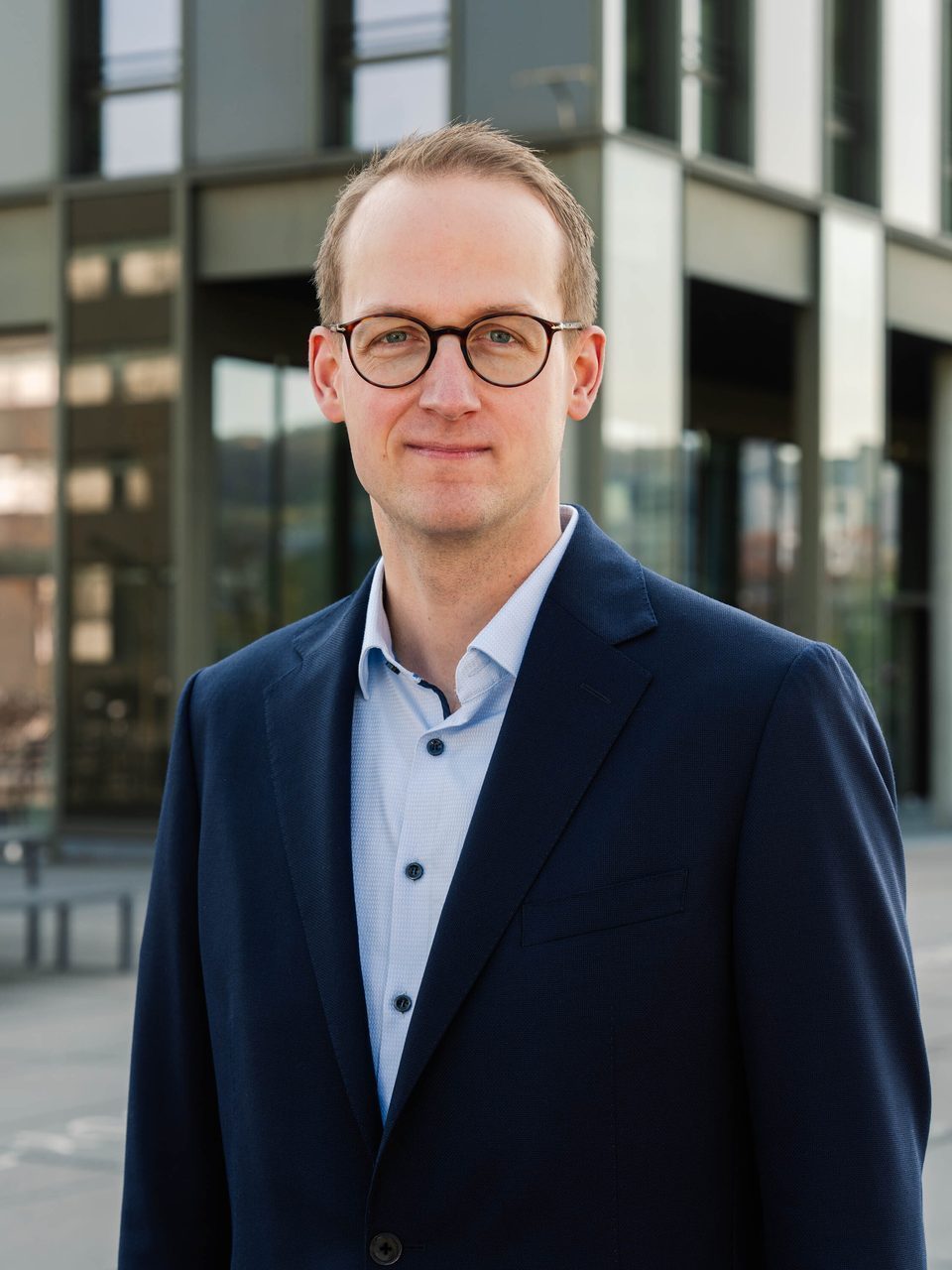
Jan Plassenberg, Jannik Daßler, Lisa Becker (GWS), Benjamin Vehmeyer, Hans Brandt-Pook (HSBI), and Frederik S. Bäumer (wonk.ai).
Three roles, four phases
The initiative came from GWS. Early internal tests showed that selection and integration are hard to do reliably without domain guidance. A classic consulting firm did not fit the profile. A single software vendor would not have carried the strategic framing.
Hence three roles that shift over the course of the project:
GWS brings the domain knowledge. A cross-team project group identifies use cases, prioritizes them, and takes them into regular operations.
HSBI (Applied AI group) brings application-oriented research and methods: needs analysis, translation into technical concepts, first prototypes.
wonk.ai takes implementation and operations: platform, integration of the prototypes, hosting, and support.
The four phases make visible who carries what, and when:
- Exploration: decision and needs analysis. Led by GWS and HSBI.
- Build: prototypes and platform. This is where wonk.ai joins.
- Rollout: trial, approval, introduction. All three partners.
- Sustaining: operations and further development. GWS runs the day-to-day work, HSBI and wonk.ai stay on in an advisory role.
That is what we mean by an external team: not delivery on demand, but shared responsibility, with a clear path for the organization to keep operations in house.
From a pilot to a family of agents
The entry point was a RAG chatbot over the GWS publication holdings. The goal: make distributed experience accessible, instead of leaving it in people's heads and folders.
Three further use cases followed the same cut: recurring, clearly bounded tasks for which structured data or texts were already there.
RAG chatbot. Access to the institute's own experience. Source: GWS publication holdings.
C++ tutor. Onboarding new staff into C++. Source: an internal tutorial.
Bid review. Completeness checks of prepared bids against the client's specification.
Tender search. Research of public tenders and funding notices, including service.bund.de and the BMFTR.
Not "we are doing AI now", but four bounded tasks with everyday value. That is where most questions at the poster started.
A platform instead of a single tool
The technical base is LibreChat, hosted by wonk.ai, with access to language models from Anthropic and OpenAI. Agents are configured via system prompts. The GWS project team can adapt them without writing code.
For tender search, an MCP server sits on top: parallel search over parameterized feeds, duplicate filtering, search terms and CPV codes in a configuration file. Domain logic stays with the institute, the platform provides the frame.
The lesson is plain. A single bot in a separate window stays a pilot. A platform on which the team can add use cases itself becomes operations.
What we learned
We put three organizational and three technical points on the poster. In Dresden they came up in almost every conversation.
Responsibilities and skills have to sit inside the house early, not only after go-live. The regular triangle of GWS, HSBI, and wonk.ai sharpens requirements and makes misunderstandings visible before they get expensive.
AI platforms differ a lot in what they can do. The choice belongs at the start of the project, not in the middle. The language model is chosen per use case, not once for the whole organization.
And the central condition for production agents is clearly defined use cases. Agent-based solutions beat purely prompt-based work. Continuous exchange between the partners was the real success factor, not any single model.
Status and next steps
The platform is rolled out company-wide at GWS. Four agents run in regular operations. HSBI and wonk.ai stay on after the project in an advisory role.
Next, AI is meant to move step by step into core work: support for scientific C++ programming (refactoring, documentation, tests) and structured research answers from the existing RAG setup.
From a single chatbot to four agents to a platform, and from there into core work. That is the arc we showed in Dresden.
What else the day showed
The workshop kept the arc we had hoped for: few buzzwords, a lot of concrete application.
The morning covered language models, multimodal systems, and industrial image processing. HSBI contributed, among other things, an evaluation of lightweight vision-language models and the TRACES project.
After the poster session, the focus shifted to AI adoption and people in SMEs. That fitted the poster. Without people who are in charge, even the best model remains a pilot on the shelf.
What we take away
The bottleneck in SMEs is rarely the technology. What is missing is capacity, ownership, and a path beyond the demo.
Cooperation beats building a department, at least at the start. Those who wait until an in-house AI unit exists lose time. Those who treat a partner only as a supplier stay dependent. The model holds when all three sides share responsibility: domain, method, operations.
Results have to be showable. At GWS that now means four agents in regular operations and a platform on which the institute can keep building.
We thank GWS and HSBI for the joint work and the open exchange in Dresden. And we thank the workshop organizers.
If you are facing the question of how to start with AI without a dedicated department, write to us.
More information about the workshop: kikmu-workshop.de