
Voice bots in the mid-market: buy or build?
Voice bots in the mid-market: use cases, buy-or-build criteria and a PoC case study. When off-the-shelf is enough, when custom build wins on cost.
- Year
- 2026
- Service
- Proof-of-Concept & Pilot
A voice bot takes calls, answers standard questions and captures requests in a structured way, around the clock. The question is rarely whether it works technically. The question is whether an off-the-shelf product fits your case or a tailored in-house build is more economical. A mid-market company tested exactly that in a proof of concept. The result and the criteria behind it.
Where voice bots work in the mid-market
Three use cases come up again and again in enquiries:
- Residential property management: Tenant enquiries and damage reports arrive in the evening and at weekends too. A voice bot captures them in a structured way, clarifies standard questions on service charges or appointments and hands the rest to the team, with a full log instead of a voicemail gap.
- Procurement: Suppliers ask about order status, invoice details or contacts. The bot handles recurring answers; the procurement team handles cases that need negotiation.
- Customer service: Opening hours, order status, spare parts requests. The bot resolves frequent cases and triages the rest.
The patterns transfer across industries; what matters is not the sector but the structure of calls: high volume, recurring requests, clear data sources.
Voice bot instead of off-the-shelf software
Starting point
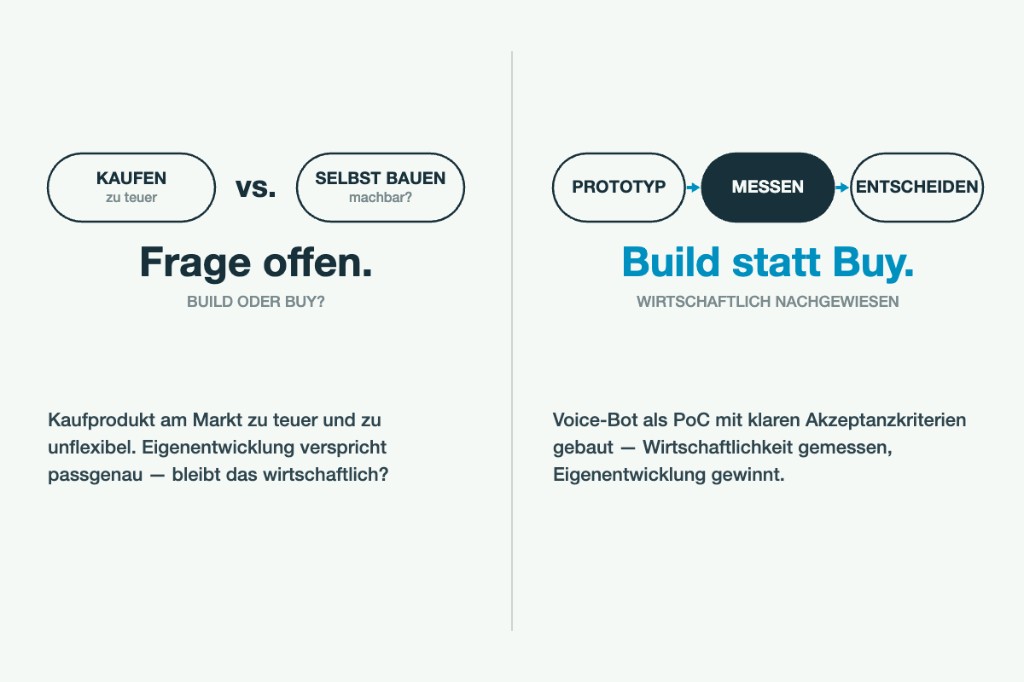
A mid-market client (several hundred employees, double-digit million revenue) wanted to automate tasks in their phone communications. The obvious option, an off-the-shelf product on the market, was too expensive and too rigid for the specific requirements. The open question: is build cheaper than buy here?
Approach
We proved the feasibility of a custom voice bot in a PoC. Fast, cost-controlled, with clear acceptance criteria. No "feels doable" gut call, but a solid basis for the investment decision.
Delivery
- Requirements analysis for the prioritised phone tasks
- Prototype covering the most critical voice flows
- Cost and effort comparison build vs. buy
- Handover into the production build
Outcome
Feasibility confirmed, economics proven. The in-house build comes out cheaper and more tailored than the off-the-shelf product. The PoC has moved into a production project at wonk.ai.
Note: Anonymised case from a funded project context. Technical details and client name on request.
Buy or build: four criteria
- Call volume and licensing model. Off-the-shelf products usually charge per call, minute or agent. At high volume, running costs grow with usage; a custom build has higher upfront cost and flatter operating cost. The crossover point can be calculated.
- Special logic. The closer the bot needs to work with your processes and systems (ERP, ticketing, domain vocabulary), the tighter the fit for standard software.
- Data sovereignty. Conversation data is customer data. Hosting in Germany and full control over data often favour custom build or an on-premise option.
- Operations. Who runs and maintains the solution? Without internal or external capacity for operations, the off-the-shelf option can be the right choice despite higher cost.
An honest take: with standard requirements and modest call volume, buying is often the better answer. That is exactly what the proof of concept as a pilot project with fixed acceptance criteria is for: it answers the question with numbers instead of gut feel, in 4 to 8 weeks. If the answer is "buy", we will say so. The same approach with a fixed frame is shown in the automating donor communications case.
Frequently asked questions
What does a voice bot cost?
Off-the-shelf products typically charge per call, minute or user on an ongoing basis; costs scale with volume. A custom build costs development once plus operations. In the project described here, the PoC proved the cost comparison concretely and the in-house build was cheaper. Which side wins for you shows up in the PoC numbers.
Can a voice bot understand technical terms and dialect?
Modern speech recognition handles everyday language well. Domain vocabulary is trained and tested in the project; that is exactly what the PoC acceptance criteria are for.
How long does implementation take?
The proof of concept with the critical voice flows takes 4 to 8 weeks. After that you can decide reliably whether and how to move into production.
Can this be done in a GDPR-compliant way?
Yes. Hosting in Germany, no use of conversations for model training, data processing agreement. The architecture is designed for this from the start.
When is the off-the-shelf option the better choice?
With standard requirements, low call volume and no capacity for operations. That is not a rhetorical option: if the PoC shows it, the recommendation is to buy.